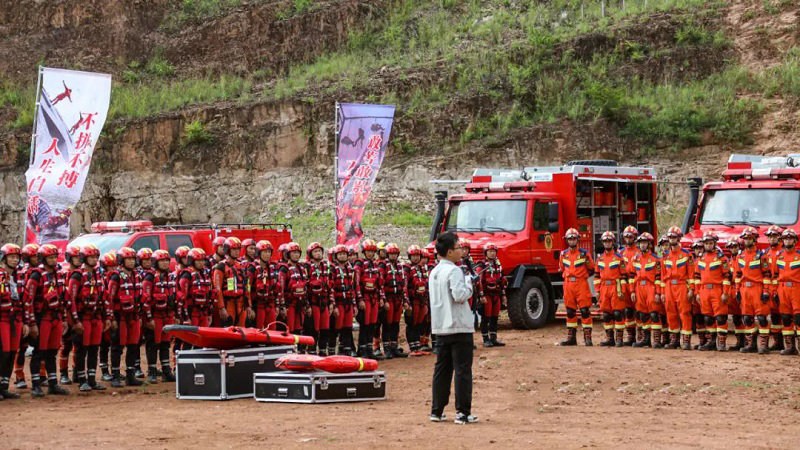
Forged Through Real Combat! Flying Lifeboat & Water Rescue Robot Lead Pu’er Firefighters’ On-Site Training!
 (Source: Zhijing Technology)
 Replacing Dry Lectures: 3D Modeling Offers Equipment “X-Ray Vision,” Fault Simulation Sharpens “Keen Eyes”
The theoretical instruction broke away from traditional models. The manufacturer’s tech team used high-precision 3D modeling to visually present the internal structures and working principles of core components like the flying lifeboat’s propulsion system and water rescue robot mechanisms – effectively giving participants “X-ray vision” into the equipment.
Crucially, targeted fault simulation drills were conducted. Facing preset complex scenarios such as “power system malfunction” or “canyon communication blackout,” officers and fighters deeply analyzed root causes and mapped out response protocols, effectively honing their ability to anticipate failures and manage emergencies.
 (Source: Zhijing Technology)
Testing Ground: Cutting-Edge Tech Faces the Crucible of Practical Examination
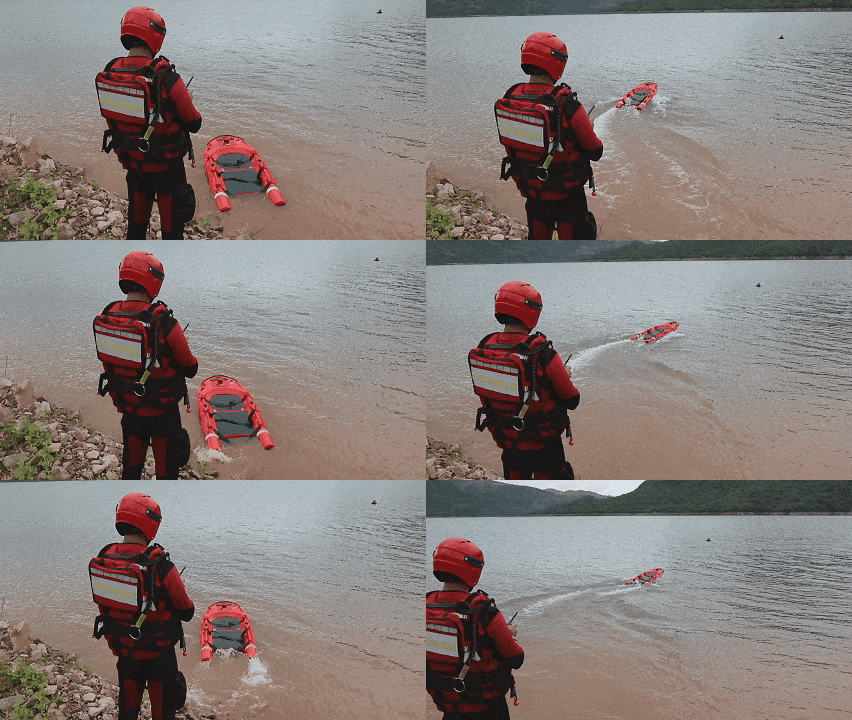
The live-fire training ground became the ultimate testbed for equipment performance. Trainees collaborated in teams, meticulously executing every step from assembly/debugging, rapid troubleshooting, to man-machine coordinated operations. Manufacturer engineers shadowed each session, offering hands-on guidance to ensure precise mastery of operational essentials.
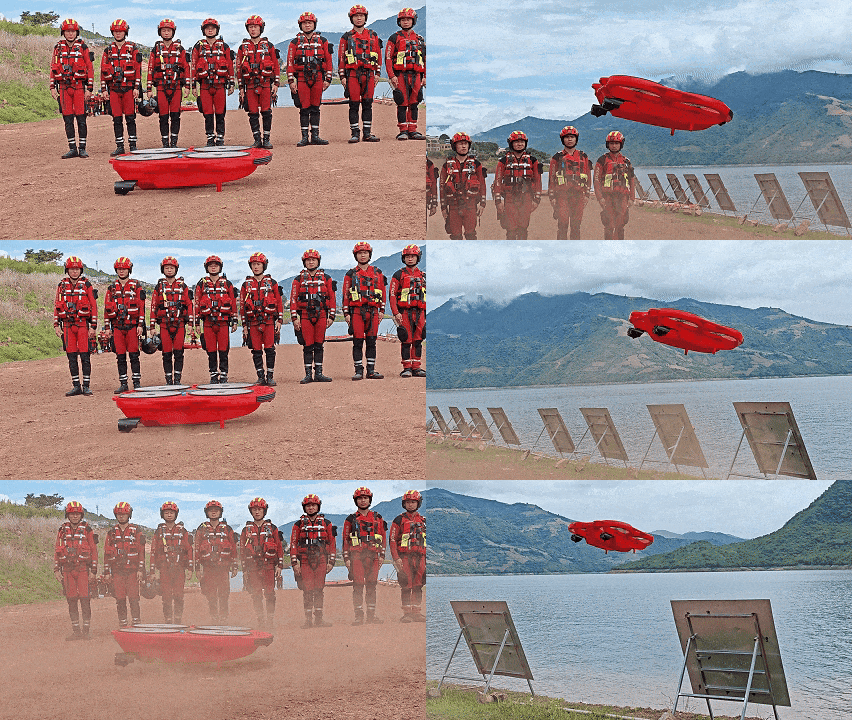
Amidst real-world challenges—turbulent river currents, submerged reefs, changeable weather—team members trained while instantly optimizing device parameters with engineers. Key skills saw tangible results: precision hovering and supply drops by flying lifeboats, buoyancy balancing adjustments for surface litters, sonar calibration for underwater drones, and coordinated victim transfers using water rescue robots.
Pushing Equipment to Its Limits Under Extreme Conditions
Embedding manufacturers deeply within this residency training aimed squarely at subjecting the equipment to a rigorous “stress test” of combat effectiveness. Torrent impacts, entanglement risks in complex underwater environments, and sudden weather shifts in canyon zones comprehensively pushed each equipment type to its absolute limits, testing reliability and environmental adaptability under extreme duress.
Valuable firsthand data collected during training, alongside identified performance gaps and operational bottlenecks, provides direct input for future equipment optimization and refined standard operating procedures.
 (Source: Zhijing Technology)
New Equipment Deployment Drives Tactical Evolution in Rescue Operations
Integration of these advanced systems is fundamentally reshaping water rescue tactics. Airborne flying lifeboats grant commanders bird’s-eye situational awareness, revolutionizing threat assessment. Underwater drones penetrate murky depths, drastically reducing search-and-localization times. Collaborative deployment of heated litters with water rescue robots streamlines casualty evacuation in harsh conditions.
By relentlessly tempering cutting-edge equipment in realistic combat scenarios, Pu’er Forest Fire Brigade not only extends its rescue reach but also takes solid strides in boosting efficiency and fortifying safety barriers, laying a robust foundation for winning future complex water rescue battles.
Technology empowers real-world operations; innovation leads rescue evolution. This deeply integrated manufacturer-supported residency training stands as a vivid testament to Pu’er Forest Fire Brigade’s commitment to harnessing technological superiority for combat readiness, injecting powerful momentum to conquer future complex rescue challenges!
Phone: 400-9013-168
Email: shelly@yuhanrescue.com

 Online Service